Have your say!
The government’s key stage 4 performance measures and targeted RISE extension consultation, seeks views on proposals to improve key stage 4 (KS4) academic performance measures, and to extend school improvement support from the Department for Education’s (DfE) targeted regional improvement for standards and excellence (RISE) service.
Progress 8 is so called because it measures the progress of pupils in England at the end of KS4 based on the 8 best scores in a combination of subjects specified by the DfE. Different systems are used in Wales, Scotland and Northern Ireland. Following the Curriculum and Assessment Review the Government sets out proposals to refresh the Progress 8 model.
We encourage all members to respond to the Government consultation. All responses must be received by 4 May 2026.
The Government proposes to continue using a slightly modified Progress 8 model based on pupil performance in 8 qualifications, divided into 8 category slots, as illustrated below.
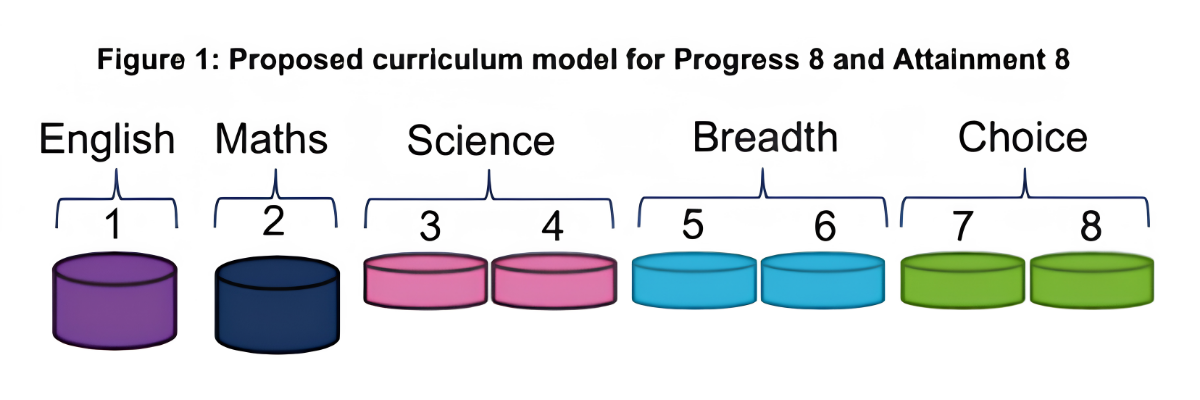
Art and design sits within the Breadth buckets. These two slots must be filled by GCSEs (or relevant AS level qualifications) from two of the three categories below (the two slots cannot be filled by subjects from the same category). These slots will take the two highest point scores from qualifications that satisfy this requirement. Technical awards in creative subjects may also count towards category B.
• Category A – humanities: geography, history, religious studies
• Category B – creative: art and design, music, drama, dance, design and technology
• Category C – languages: modern foreign languages and ancient languages
Below we set out NSEAD’s answers to the consultation questions to the sections on KS4 performance measures, which members may wish to refer to in their responses.
NSEAD Position
Question 11
How far do you agree that these changes to the Progress 8 model strike a better balance between breadth and flexibility compared with the current P8? Please explain your views.
NSEAD response:
We welcomed the removal of the English Baccalaureate (EBacc) as an important move to address the hierarchy of subjects that has degraded the status, number of hours taught at KS4 and the quality of provision for art and design. Whilst we are pleased to see that Art and design secure within the breadth of choice slot, these minor changes to Progress 8 will do little to restore arts subjects. Whilst there is some adjustment, the weighting of buckets one and two maintains a subject hierarchy that we believe to be harmful. Arts and sports remain at the bottom of this ladder. The message is still being sent that some subjects matter more than others. This does not align with the national curriculum, where all subjects have (in theory) parity, or the Ofsted evaluation framework, or the requirement for a broad, balanced and inclusive curriculum.
As proposed, the restriction on the two Breadth subject slots, with arts subjects grouped in category B means that students can only opt for one arts subject. They can however opt for additional arts subjects (subject to disqualifying discount codes) which would be counted under the Choice slots 7 and 8. Under current Progress 8 measures those students who want to study a combination of arts can technically do so within the three slots within the open ‘bucket’. The proposed revisions also permit 3 of 4 slots to be filled by arts subjects, maintaining the status quo but does not increase opportunities to study more than one arts subject.
We do not believe that these minor reforms are sufficient to meet the Government's intention to provide an arts rich education that improves SEND provision and protects children’s entitlement to arts and sports education.
__
Question 12
What are your views on the inclusion of a fourth category (science) for breadth slots 5 and 6?
NSEAD response:
Whilst we recognise that adding a fourth category to slots 5 and 6 would increase student choice, it would reduce breadth and not create any additional entitlement to arts subjects.
If Design & Technology were to be moved from category C, and grouped in the proposed category D along with science and computer science, this would serve to define category C very clearly as an arts entitlement, with different approaches to design education sitting across both category C and D. This could be a strength and opportunity for art and design and design & technology to be understood as distinct subjects offering complementary not overlapping approaches to design education. This would need to come with clear messaging about why students interested in design can benefit from the study of both subjects.
We broadly support the introduction of a fourth category, if it includes design & technology.
__
Question 13
Do you agree that Progress 8 should allow technical awards in the breadth and choice slots, with a maximum of two across all slots?
NSEAD response:
We agree that technical awards offer a valuable vocational alternative to GCSEs and are an important feature of a broad and balanced curriculum and support their inclusion in the breadth and choice slots. We would take issue with the characterisation of these awards as weakening an academic core offer or being presented as a less demanding course of study.
__
Question 14
Do you have any comments on the minor methodological adjustment?
NSEAD response:
We recognise that the impact of school size on bandings is unfair and places a burden on smaller schools. We support the use of percentiles to set bandings and create a more useful range to differentiate between performance.
However, the ranking of schools based on outcome data is a reductive measure of the value of a rich and broad education, and the holistic development of pupils. We would prefer to see a balanced picture that includes consideration of how all pupils are supported to progress.
__
Question 15
Do you have any other comments on the proposed changes?
NSEAD response:
We do not anticipate that these minor changes to the grouping of slots will have a significant impact on provision of art and design in schools given that staffing and resourcing remains a challenge. The revisions do position the arts more clearly within the accountability framework however, and this is welcomed. We remain concerned that the opportunity to dismantle the notion that there is a hierarchy of subjects, has not been taken. Narratives of value are not challenged in the proposed structure. Beyond this, we note that the baseline for progress measures is still KS2 performance in English and Maths. This continues to support the premise that some subjects matter more than others.