Draw Like A Boss
In this interview, author of Draw Like a Boss, Ashley Edge, talks with Paul Carney, former art and design educator, now art practitioner and author. Ashley and Paul explore the purpose of drawing and learning to draw, including explicit instruction.
_____
Paul Carney: There are many approaches to teach drawing. Can you talk me through yours? What is the over-arching philosophy behind the design, content and structure of the books?
Ashley Edge: When you learn, you’re literally reshaping your brain. It’s internal world-building. I see drawing education as a landscape with its own territories, cultures and challenges. I want people to sit at their desks and feel they’re on a journey toward a summit, the mountain is the central metaphor of the book. I’m not interested in students trying to memorise a concept only to forget it five minutes later; I want them to encounter theory as a living character. Drawing is visual, and it should be taught that way.
PC: Why do you think people should learn to draw? After all, in your book, you admit that most adults cannot draw and see it as a genetic talent, and these days you can use AI to generate images. If so few people draw, is it even important now? Is drawing just a peculiar, old-fashioned hobby?
AE: In the first book, I begin by attempting to do away with the idea that genetics plays a part in someone’s ability to draw. And, although most people can’t draw to a high level, by practicing in a certain way and having the right learning resource to motivate them, there is nothing to stop them from doing so. Talent is a useless word because it either masks the hard work someone has put into getting to a high level or it gatekeeps students from ever thinking they can pass a certain threshold. Picking up a pencil is the first step, internalising the basic principles is the next. After that, you can draw.
As much as AI casts a shadow over creative jobs, the good news is that drawing, like meditation and the appreciation of craft and aesthetic, is never going away. Drawing is more important than ever because it can be used to temper our fast-paced lives. Going slower at certain points in a day is a healthy thing to do. It encourages mindfulness, and allows us to work through emotions and experiences and channel these ideas onto paper. If creating art was purely about the conclusion or the act of selling it later, then AI poses a great threat. But art is as much about the journey as it is about ‘having the thing’ later.
There’s been plenty of talk about AI being a tool like Photoshop, but Photoshop can’t paint the picture for you: therefore, AI is not a tool in the same way. It is more like a crutch that you can lean on, but the more you come to rely on it the more you come to outsource your own creativity to a machine and risk the atrophy of your own artistic voice.
Drawing enables people to ‘see’, which is very different from the act of just ‘looking’. I wouldn’t trade that gift for anything. I know what it feels like to get a drawing to the level where I feel like I am reaching into the paper and sculpting the forms. Drawing is pure alchemy.
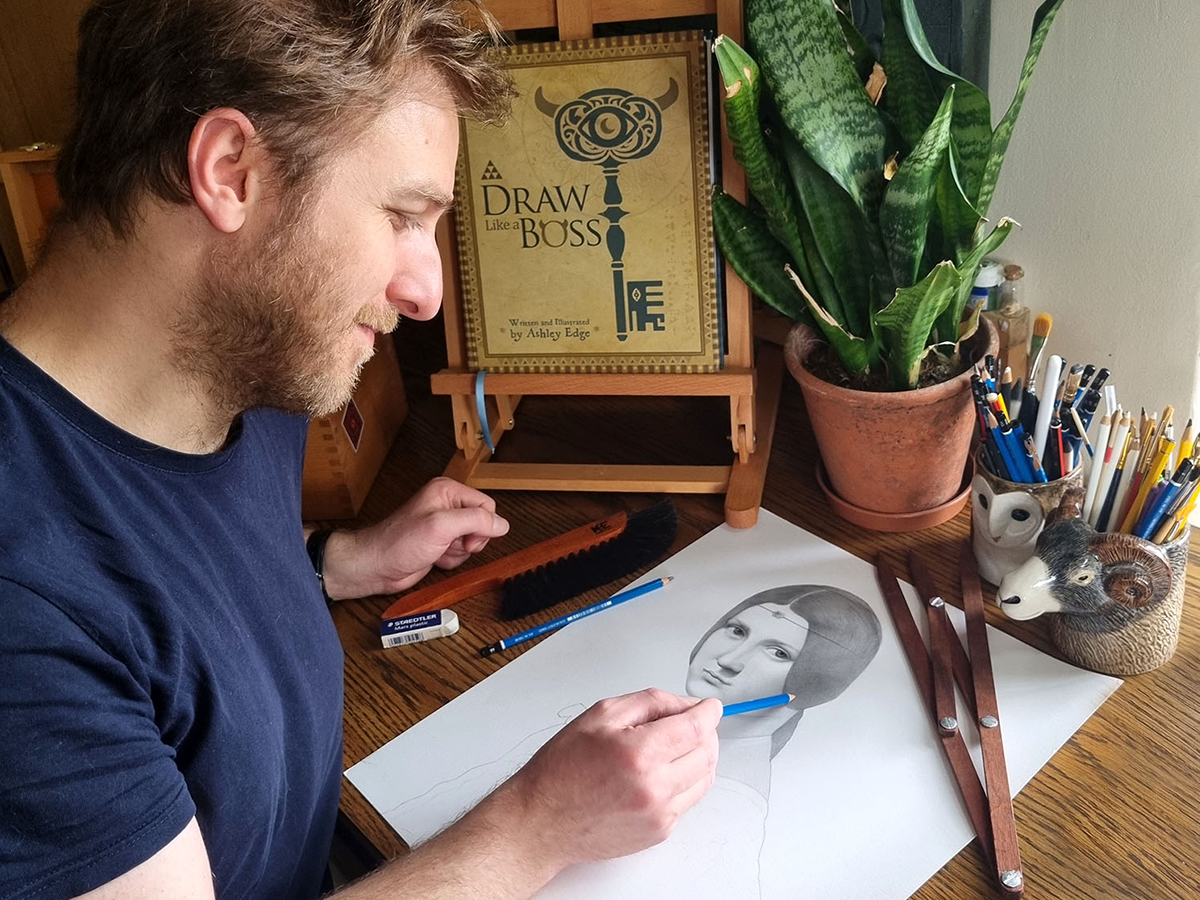
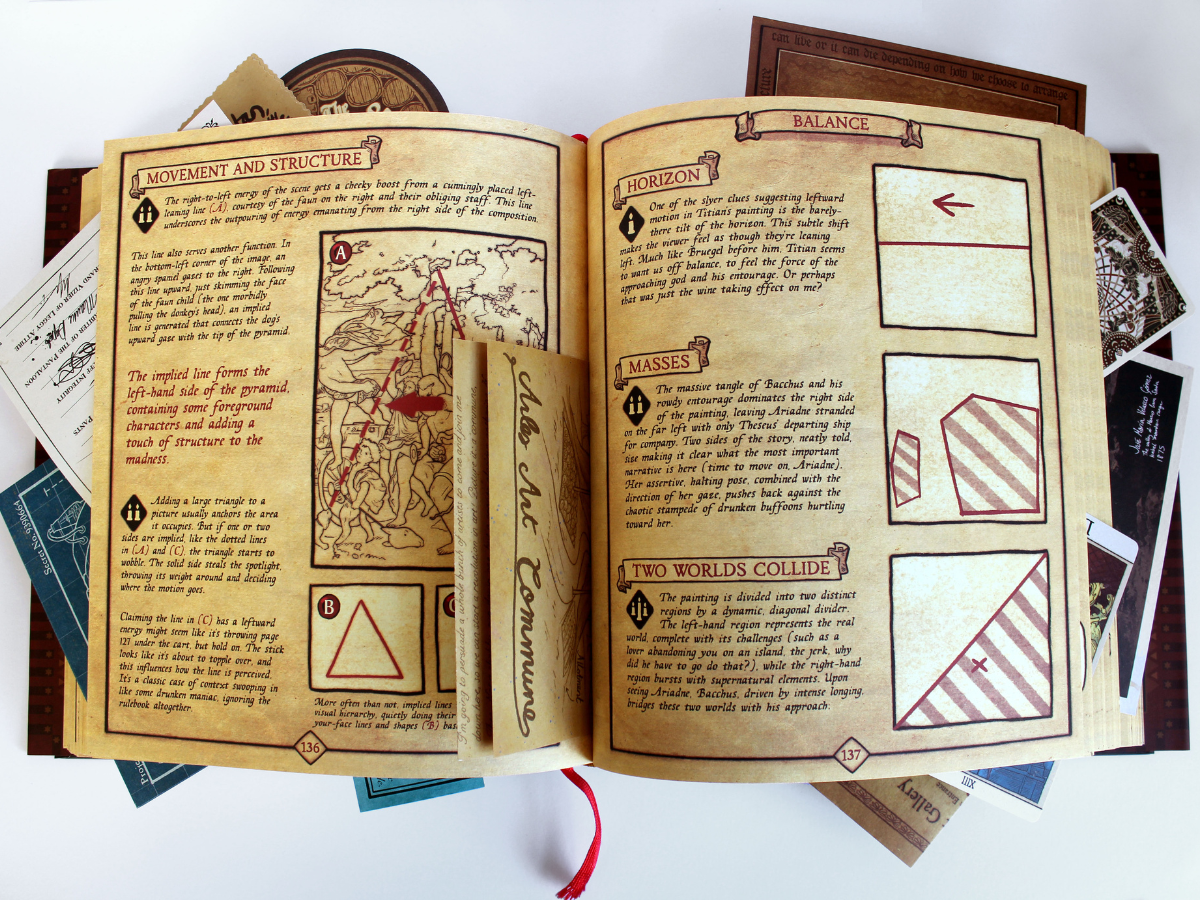
PC: Draw Like a Boss 3 is a masterpiece of art history analysis. You brilliantly deconstruct significant historical works of art to provide readers with an understanding of how they were composed. I can see teachers utilising many of these exercises in their lessons. However, some educators may be disappointed that only one female artist is studied and even then, there are no examples of non-western art. Can you share how you decided which artists should be in your book(s)?
AE: My priority for book three was to choose works that best illustrate the ideas I wanted to teach: composition, light, rhythm and unity, rather than curating by artist identity or geography. Art history is vast, and the artists in the book reflect one path through it, not the only one. I grew up immersed in western art, and that’s the perspective I can speak from most authentically and from this foundation, my aim was to help readers see how these principles echo across time and style, and to enjoy art history in a way that sparks their own exploration.
Draw Like a Boss 3 mostly speaks about artists who worked throughout the 18th and 19th centuries, a period when women were sadly underrepresented in the historical record. Rosa Bonheur is included not as a token, but because she perfectly exemplifies the compositional principles I wanted to highlight at that point in the story. When I create the online digital version, I will broaden the canon.
PC: I do love the autodidactic, gaming approach you employ to teach drawing. It’s something I would have loved when I was a kid. In my own art education, teachers were reluctant to give explicit instruction for fear of destroying the pupils unique creative voice. I found this very frustrating at times, and taught myself a lot of stuff from library books. Do you think creativity is stifled or enhanced by explicit instruction?
AE: Gaming has evolved to make learning feel seamless, from icons and layout to characters and narrative, every element is designed to guide you intuitively. I wanted the same for art education. Good instruction doesn’t stifle creativity; it clears the path so the creative impulse can actually flow. When the structure is clear, you’re not stuck wondering what to do next. You’re free to focus on expression and discovery.
PC: I can see secondary, even high school pupils who are into fantasy, gaming culture being very interested in your books. Was that your intention? Who do you see as the audience for your books?
AE: The audience I had in mind was my sixteen-year-old self, someone hungry to learn but without access to formal training.
Draw Like a Boss isn’t aimed at children, nor just at fans of fantasy. Veteran artists from Disney, Pixar and Industrial Light & Magic have their own copies, and teachers in academies all over the world use the books to teach adults.
While there are characters and illustrated worlds to frame the journey, both adults and younger readers tend to enjoy the visual format. It makes the theory easier to digest without ever diluting it. The friendly tone simply takes the edge off what could otherwise feel like a serious and demanding course.
PC: Draw Like a Boss requires a long commitment on behalf of the pupils. What strategies have you used in the book to maintain the concentration of the reader?
AE: Narrative and clear structure keep the course from becoming sterile or ambiguous. The progression takes inspiration from how levels unfold in a video game: each stage builds naturally on the last. If students follow that path, they’ll see results, and that momentum sustains focus. Confusion and frustration are anathema to learning, so I’ve worked to remove as many ‘quit moments’ as possible.
About the authors
Ashley Edge is a Lake District based artist and the author of the Draw Like a Boss series of books turning learning to draw into a fun quest. He did a BA in Illustration and Animation at Manchester Metropolitan University but it felt somehow incomplete. A fan of video games, Ash started studying academic drawing in his free time and eventually developed his own drawing formula blending the discipline of classic art with the playful spirit of gaming. With Zelda and Monkey Island as inspiration, he created the kind of books he wished he’d had when he was learning.
Draw Like a Boss: Book 3 | £60
Facebook: @drawlikeabossuk
Instagram: @drawlikeaboss_books
Paul Carney is a retired art and design educator, now art practitioner, author and thinker. Most days, he can be found in his art studio painting and writing, or in his garden tending his plants. He is the author of four books: Drawing for Science, Invention & Discovery, Drawing to Learn Anything, Classroom Catastrophe’s, his humorous autobiography, and a novel The Arthrobot Scriptures. His current writings examine science, philosophy and theology to better understand the nature of existence. Paul believes passionately in equality, fairness, rationality and anti-racism.