Reflections on practice led experiential learning
Kenneth Newlan, former FE art and design teacher, reflects on the positive impacts of a series of residential study trips to Pembrokeshire and Devon for full time BTEC and Foundation Art and Design students, between 1978 – 1983.
Newlan argues that learning outside, in all weathers, creates opportunity to use haptic and tactile senses, and the conditions that develop immersive and independent learning.
Students were encouraged to work independently outdoors no matter the weather. The results – from the less able and shy students, to the more confident and assertive – were phenomenal. Students would fail one day and the next day, in worse weather, could excel. Evening reviews were intense and dynamic.
These were not ‘away days’ or gallery trips: the residential courses were arduous, productive and importantly – fun.
The context
At the time of the residential courses, the FE curriculum was faced with diminishing resources (FEFC 1996), shifting regulations and rules.
For the art and design students, the courses were opportunities to reflect and engage in active reflexive learning over a number of days: away from controlling, institutionalised regimes and powerful ‘ocularcentric’ leanings (Jay 1993; Pallasma 2012). Learners were used to project-based learning, often circumscribed by subject definitions.
The residential courses immersed learners into sensorially challenging environments of doing and making, where they responded to a mixture of direction and independent learning which induced subtle shifts in group dynamics.
Professionally, the courses required an unusually close relationship of trust between teacher and student. The risks teachers implicitly took in shepherding a group of young people into the countryside are obvious and teachers greatly relied upon their peers to prepare cover in their absence. Teachers acted as facilitators more than instructors and they shared the physical challenges the students faced. The challenges for teachers to their enthusiasm, commitment to the students, and expertise were to be a testing rite of passage.
Why this matters now
The prioritisation of vision above all other senses in art and design education persists – as well as the production of two-dimensional outcomes – and is reinforced if anything by reliance upon digital depiction and simulated sensory experience.
The haptic and tactile senses need to be constantly revisited and developed (Paterson 2007). Restrictions on resources and increasing regulation will no doubt continue. Opportunities to develop ‘lived experiences’ to keep the curriculum alive – for students and teachers alike (Bruner 1966) – were and are necessary.
The residential courses
The courses were residential study breaks of four to six days as foundational experiences, designed intuitively with elements of experiential learning (Dewey 1938; Kolb 1984) and project based / expedition learning (Piaget 1936; Vygotsky 1978; BTEC 1983).
The courses were carefully planned and lightly circumscribed. Students shared accommodation, ate together and planned their own day, to an extent. Their daily practice could amount to survival practice, in force four gales. Students, often exhausted, took part in rigorous evening ‘crits’ when the day’s works were displayed, almost always to stunning effect. Students could not fail but to learn from each other’s successes and failures. The compression of work and subject immersion is not easily replicated in colleges nor schools.
Interestingly it was my impression that if a student had disappointing results one day, they would not necessarily recover lost ground the following day but inevitably did produce better work on a third day. Hence the significance of at least four or five-day courses.
For teachers and course leaders, the opportunity to even temporarily escape the regulation of awarding bodies and college pressures and protocols, and even the veiled hegemony of HE’s definitions of subject characteristics, was valuable. Courses were opportunities to learn how to elicit responses from students in challenging situations, to inspire the shy and encourage the more confident to share their enthusiasm. In a four or five-day period, the daily rhythm of prep, proceed to site, look, experiment, return, reflect and record was as valuable for teachers’ experience as for students.
The purpose of the residential course was simply the visual study of accessible natural sites and materials, and importantly the opportunity to work independently and collectively: free from interruption, as well as sharing the discoveries with fellow students.
Course Exemplar #1: National Trust Countisbury
The cohort:
35 students, including a group of second year BTEC General Art and Design students; a group of post A-level Foundation students, including four adult students; two teachers, and an assistant who led the self-catering cooking teams.
The venue:
A National Trust property with field-course accommodation. Facilities were cramped and basic. It was early in the academic year, late October. The weather looked dire, for the five-day course. The college provided generous amounts of materials, paper, paints, glue, masking tape, gum strip, polythene sheeting, charcoal, string and brushes. We brought our own food and pre-planned menus. Students provided their own sketchbooks, drawing and painting materials and maybe cameras.
Day one:
Walk and scoping to Lynmouth Beach, Watersmeet and the Lyn valley, taking notes and sketches. In the evening, students and teachers discussed possibilities for drawing, collecting and making in these areas.
Day two:
It was raining and the setting was for a collective sketchbook session down a steep cliffside path to a broad shingle beach. The majority of students headed directly to the beach; some students headed back to dry accommodation and all were firmly led back to the beach to ‘work with the weather’. Needless to say, the results were limited, but some shelter was found. For evening review, many pages disappeared in a pulp including lunch material. They were astounding in the range of imagery and invention. The visceral power of the collective energy – focused in appalling conditions – was evident in the pride of the students.
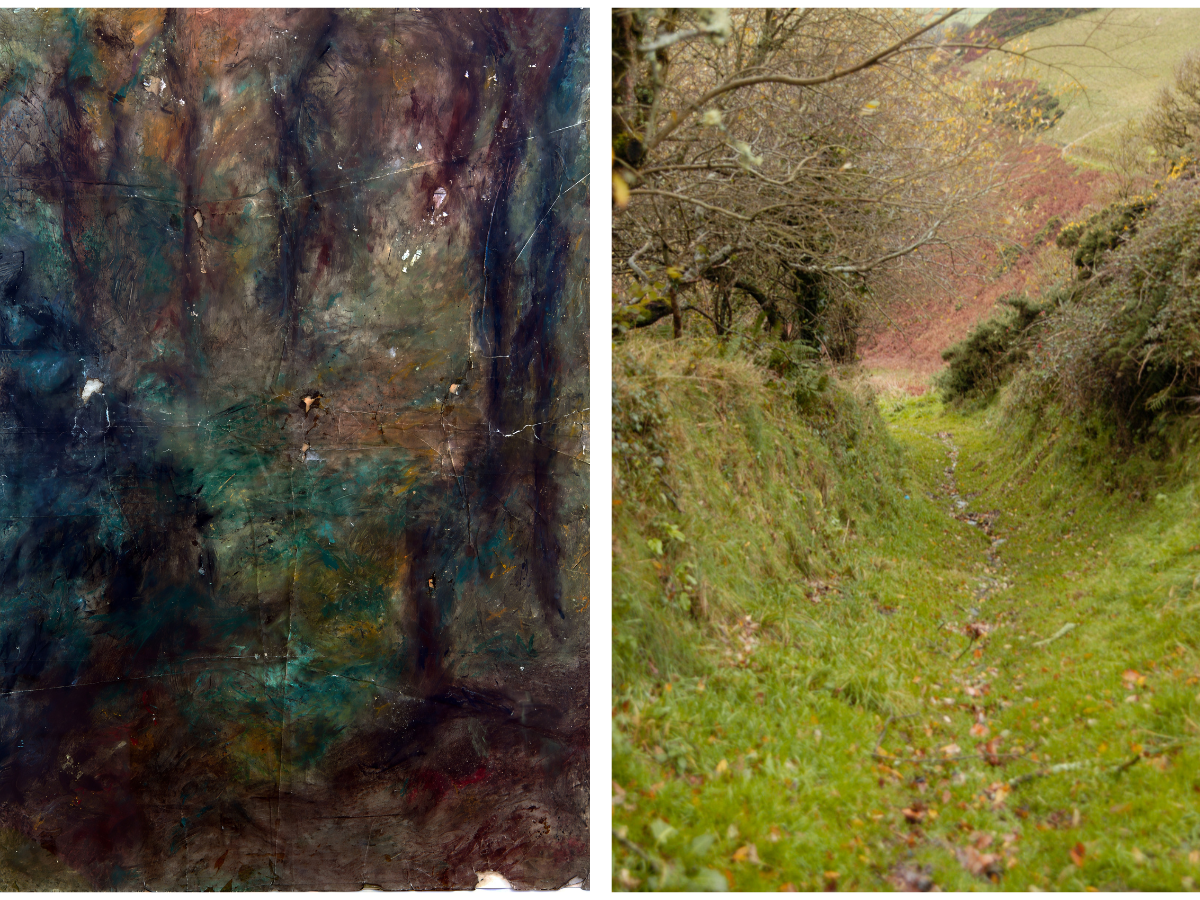
Images 2 & 3: Student artwork (left) and site inspiration (right)
Day three (half day):
Students negotiated a site within the Lyn Valley and Watersmeet, and chose their own way to express their impressions and record what they saw. In the afternoon, a leisurely visit to Lynmouth. In the review session some students decided to return to their site or choose another.
Day four:
Students selected new sites. The evening review was brief preceding a riotous fancy dress party!
Day five:
Return to London. All work was carefully packed and loaded onto the coach for return (it filled the rear of a sixty-seat coach).
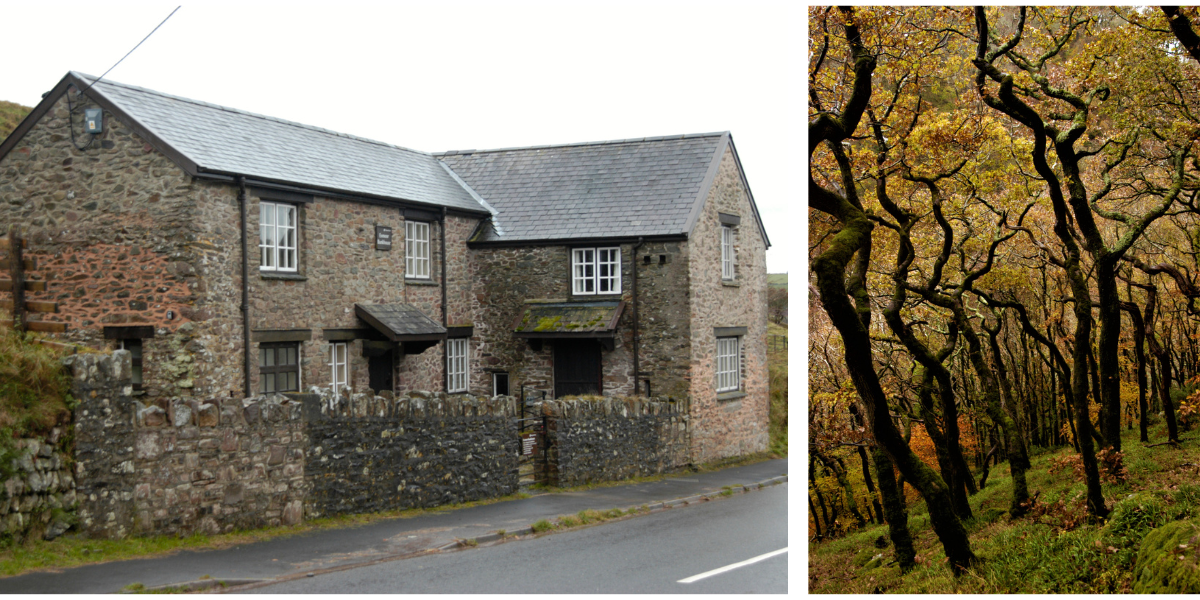
Images 4 & 5
Course Exemplar #2: National Trust Stackpole
In a subsequent year a course was planned for a similar cohort, as a self-catering four-day course based at National Trust Stackpole. The schedule was initially more constrained, aimed at encouraging students working primarily independently, and reviewed collectively each evening.
Day one:
All walked and drew on a three-mile route through the whole National Trust site, stopping occasionally at prospective drawing sites well-spaced apart. Each site was numbered and marked with a wooden stake. In the evening review, students chose and explained their preference for their site for day two.
Day two:
The Square Metre: each student returned to their selected site, marked the day previously, and staked out a square metre shape and painted / drew what they observed within the shape, at 1:1 scale. Students drew across paths, over rocky outcrops, included trees or water. Results were equally concentrated and focused away from picturesque tropes.
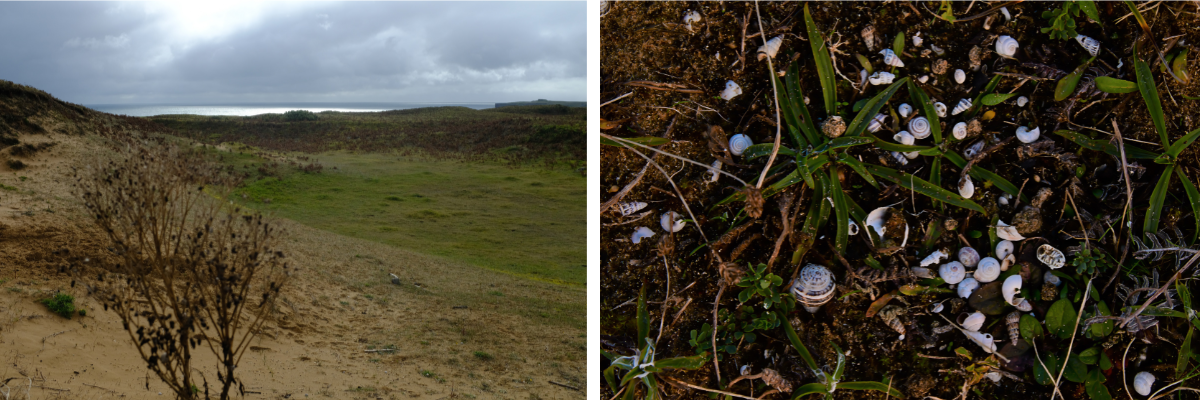
Images 6 & 7
Day three:
Students returned to their selected site, and drew / painted looking away from the site.
Day four:
Students negotiated a site each, which they had visited the previous day, to study independently (from each other and lecturers). Students produced completed paintings and drawings, many with supporting sketchbooks.
Day five:
Return to London. The returning coach was crammed with even more work than the previous year.
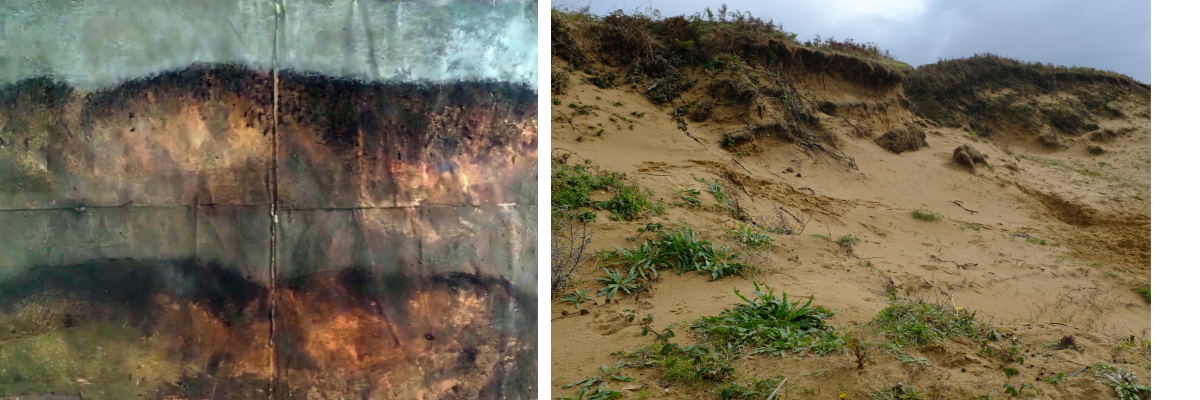
Images 8 & 9: Student artwork (left) and site inspiration (right)
Work produced during the residential course was later displayed in a very large space at the college. The variety of work was intriguing – constructions, paintings, collage, papier mâché, found objects – the focused invention and sheer productiveness of the students was evident.
Conclusion
These and subsequent courses were successful for a number of reasons, not least the enthusiasm of the leaders and the support from their colleagues: classes had to be covered, learning of students not attending the residential accommodated, emergencies catered for. Costs to students were kept low, grants found (e.g. Labour’s Capital Challenge), and results were maximised for assessment and produced exceptional portfolio work.
Other key features:
- Location – away from tourists with space to work in isolation
- A cohort committed to art and design, valued as a study path: mixtures of study groups made it easier to avoid established intra-group hierarchies
- The pattern of work / evaluation was essential
- A creative, bespoke schedule
- Very generous amounts of materials and encouragement / direction to use them
- Planning, including the demonstration of what ‘waterproof’ looked like!
- Mixture of ‘behavioural’ direction / individual choice: instruction if requested
- Teamwork – self-catering accommodation, if possible, with rotation of cooking, serving teams
- Parallel timetable for students who did not attend the residential course
- Supportive staff at the National Trust locations
There are multiple reasons why such field courses for art and design may be dismissed. These include the prevalence of mobile phone distractions; risks for teachers; the need to include more ‘technical’ e.g. on-site or photographic work; reduced teaching and learning hours; risk-averse colleges and schools; cost to students; fractured teaching responsibilities; and more part-time teachers.
All of these obstacles are worth surmounting, as we found the advantages in exposing students (and teachers) to hard independent work, fun and its consequent benefits for their confidence was priceless.
Postscript
As part of a research project on curriculum in FE art and design, I interviewed three participant teachers of residential field courses. One leader was an art adviser for a south-eastern county; another a headteacher / geologist from Norfolk; and a course leader from a London college. Each of them was in no doubt of the seminal importance of these intensive study experiences.
The art adviser noted that despite art graduates starting out as radical, they soon get swallowed up in homogeneity. He continued, ‘drawing as an ongoing experience doesn’t happen... it’s been written out of the equation... Recording firsthand experience, which when I was a young teacher was driving a lot of the work … happens far less...’
‘For example we used to take students on residential trips and get up at five o’clock in the morning... we would take them down to St Margaret’s Bay in the dark without telling them what we were going to do – and then the sun would come up, and they saw for the first time in their lives the sun come up over the sea, and the rocks behind them, and they suddenly knew what they wanted to draw and record.’
The geology teacher thought some essential features were firstly, ‘governors responsible for appointing Heads who can embrace the broad curriculum'; ‘dedicated enthusiastic teachers’ with a primary interest in the engagement and development of students; and ‘teachers who were prepared to go the extra mile [and had] enjoyment of the subject… a new environment, seeing things afresh.’
The FE Head of Department had experience on dynamic French residential courses led by ‘gifted and charismatic teachers’ and the ‘benefits to learning that could take place outside the confines of school’. Subsequently, he took that experience into FE colleges, along with his own interest in the land art of Richard Long, Christo, Andy Goldsmith, Robert Smithson, etc. He said, ‘it was that combination of factors that made me want to develop “the field course”.’
About the author
Kenneth Newlan studied sculpture at St Martins School of Art, taught 3D and sculpture and managed departments in colleges of FE/HE. 2016. Consultant and manager in college improvement and conducted EdD with Sheffield University on the further education art curriculum. Curated and commissioned for private sculpture collection until 2008. Continues to work across sculpture and photography.
Images
1 (Header). Lynmouth and beach, National Trust Countisbury
2. Roadside pathway (A1, paint and mixed media)
3. Roadside pathway, National Trust Countisbury
4. The Bunkhouse, National Trust Countisbury
5. Watersmeet ancient oaks, National Trust Countisbury
6. Landscape, National Trust Stackpole
7. Dune floor, a 'square metre' site, National Trust Stackpole
8. Stackpole dune (4 x A2, paint, charcoal and mixed media)
9. Stackpole dune, National Trust Stackpole
All images © Kenneth Newlan
References
BTEC (1997b) Teaching and Learning Strategies. London. Business and Technician Council.
Bruner, J. (1997) The Process of Education. Cambridge, Harvard University Press.
Dewey, J (1938) Experience and Education. London Penguin.
FEFC (1996) Report from the Inspectorate. Art Design and Performing Arts. Coventry.
Jay, M. (1993) Downcast Eyes: The Denigration of Vision in Twentieth-Century French Thought. Berkeley. University of California Press.
Kolb, D. (1984) Experiential Learning. Experience as the Source of Learning and Development. N.J. Englewood Cliff: Prentice Hall.
Pallasmaa, J. (2012) The Eyes of the Skin. John Wiley & Sons. London.
Paterson, M (2012) The Senses of Touch. Haptics, Affects and Technologies. Oxford: Berg.
Piaget J. (1958) The Growth of Logical Thinking from Childhood to Adolescence. New York, Basic Books
Vygotsky, L (1978) Mind and Society. Cambs. Mass. Harvard University Press.