NSEAD x APECV Inaugural European Exchange - Sharing Cultures
In July 2026, a delegation of NSEAD Council members joined colleagues from APECV for an international exchange event in Portugal. It is hoped that this inaugural exchange will become an annual European gathering for members from both organisations to share innovative practice in art and design education. In this article, Rebecca Twiston-Davies reflects on the event and the key questions which were raised during the visit.
From 24 - 26 July 2026, Casa da Imagem in Villa Nova de Gaia, Portugal, hosted the first international meeting of the National Society for Education in Art and Design (NSEAD) and the Association of Teachers of Visual Expression and Communication (APECV). With a focus on the theme ‘Sharing Cultures: Inclusion in Art and Design Education’, the three-day exchange bought together art and design teachers and educators to engage in professional dialogue, the sharing of research, and collaboration in creative workshops.
The purpose of the exchange grew out of a desire to address shared concerns and challenges, disseminate knowledge, collaborate across borders and to foster new and enduring connections.
Throughout our time in Portugal, NSEAD delegates returned to key questions:
- who and what is represented in the art and design curriculum?
- what does inclusive practice look like in our subject?
- how can a cross-border exchange of knowledge strengthen connections and develop a community of practice for mutual support and innovation?
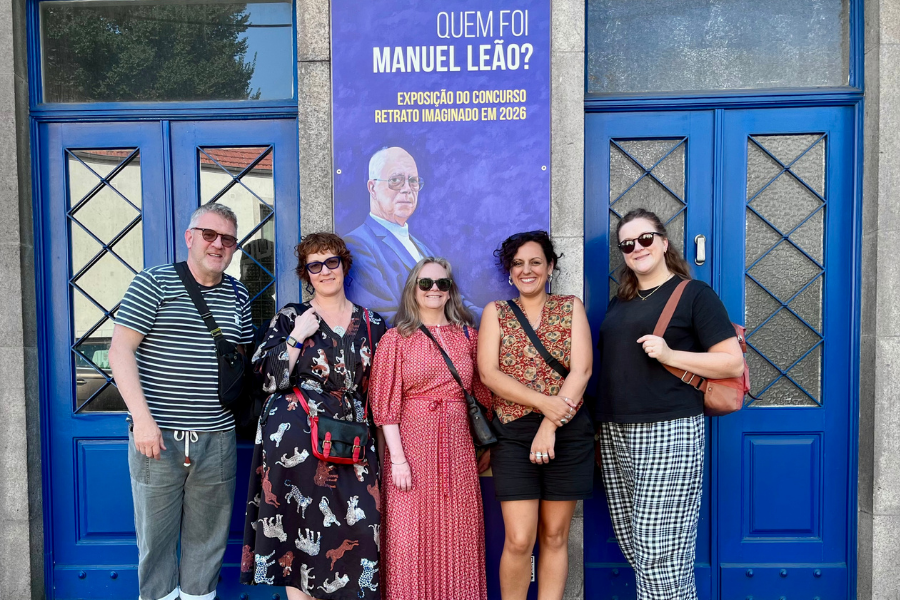
Image 1
The NSEAD delegation (above) comprised council members Emma Sutton (President-Elect), Clare Stanhope and me, alongside NSEAD President Andy Ash and General Secretary Michele Gregson. We were joined by colleagues from APECV and our hosts Casa Da Imagem (House of the Image) to share stories and practical examples of inclusion in our varied settings and practices.
Our co-hosts APECV share an affinity with the aims and concerns of NSEAD: they are an association of professionals linked to art education and visual arts teaching, based in Portugal. They work in and advocate for the field of visual arts education, providing learning opportunities through participatory projects in formal and non-formal educational settings and the creation of open-access educational resources.
Casa da Imagem provided the ideal location for us to meet. It is a cultural centre near Porto dedicated to artistic practice, creation and research, working with communities and organisations to build a fairer society through arts participation and education projects in Portugal and beyond.
In his opening address, NSEAD President Andy Ash shared key aims for the exchange, ‘During this visit we have chosen to focus particularly on the theme of inclusion. This feels both timely and important. Inclusion is not simply a policy or an aspiration; it is something we create through our everyday practice as educators. It asks us to think carefully about whose voices are represented, whose stories are told, whose experiences are valued and how every learner can find a sense of belonging within creative education.’
Rights Representation workshop – Narcisonline
The first full day of the exchange began with a Rights Representation workshop, led by young adults from the Grijo Social Inclusion Center and colleagues at Casa da Imagem. The group had participated together in ‘Narcisonline’, a long-term project examining online safety, social media and communication through the lens of intellectual disabilities. In practice-based workshops using mapping, photography, analogue and digital tools, the project grappled with participation in online spaces, and empowered participants to use digital platforms more consciously, critically and safely.
The outcome of the project will be a code of good practice for use in policy, it is hoped, at national level in Portugal, to provide companies and organisations with strategies to adapt their working environments to support those with disabilities. The code of practice is based on symbols generated by the group to communicate three important rights: the right to support, the right to work and the right to friendship.
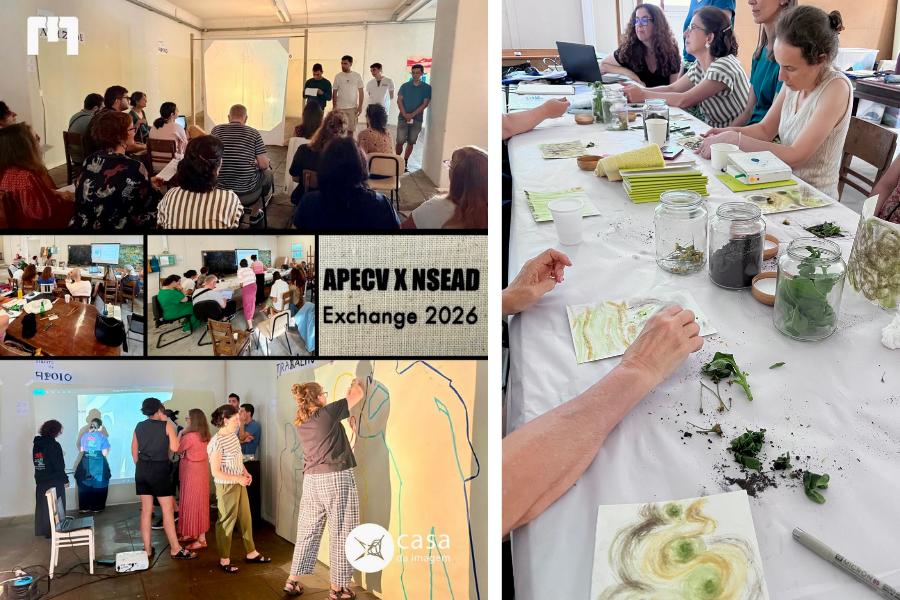
We were invited to depict these three rights through shadow play, working in pairs to project and layer our bodies to convey symbols such as ‘support’, ‘listening’ and ‘care’, considering how these actions might be interpreted in complex digital spaces (Image 2). Taking the shadow silhouettes, we further translated the rights to support, work and friendship by tracing our bodies onto large-scale paper using paint, tape and drawing (Image 3). Much of the work was made non-verbally or by communicating through gestures and simple phrases, enabling the group to work together despite our different spoken languages. Throughout the workshop the group experienced much laughter, joy and care.
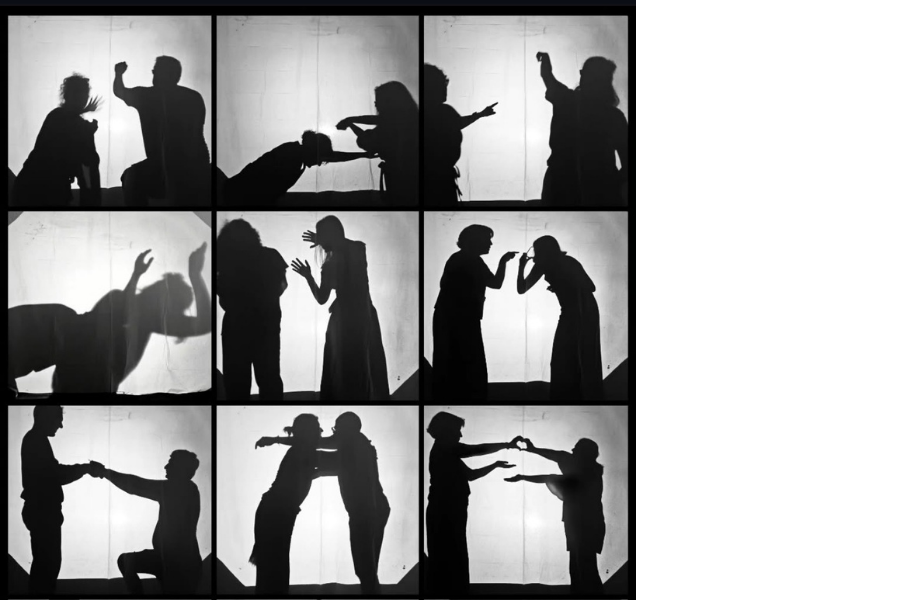
Image 2
Inclusion, empowerment and empathy – sharing approaches
The atmosphere of the exchange felt radically generous, rooted in support, community and honest exchange with a programme that was designed to be active, collaborative and practice-based. The exchange continued through Saturday and into Sunday, via critical conversation, further collaborative workshops, talking while walking the city (dérive) and sharing good food.
There was no pressure to present anything but many of the group chose to share their experiences of working inclusively in classrooms, in non-formal learning spaces, with community groups and to test research undertaken at Masters and PHD level. The workshops and presentations took place in a relaxed setting, a series of free-form rooms, so inclusivity felt embedded in the very heart of the exchange.
Local University PHD student Claudia Ormonde shared her research through a practical workshop centred around ‘F[r]iction as a Critical Metaphor in Environmental Art Education’ (Image 4), and we deliberated practice-based research methodologies with PHD students Maflada Carreira and Sofia Santos.
Images 3 & 4
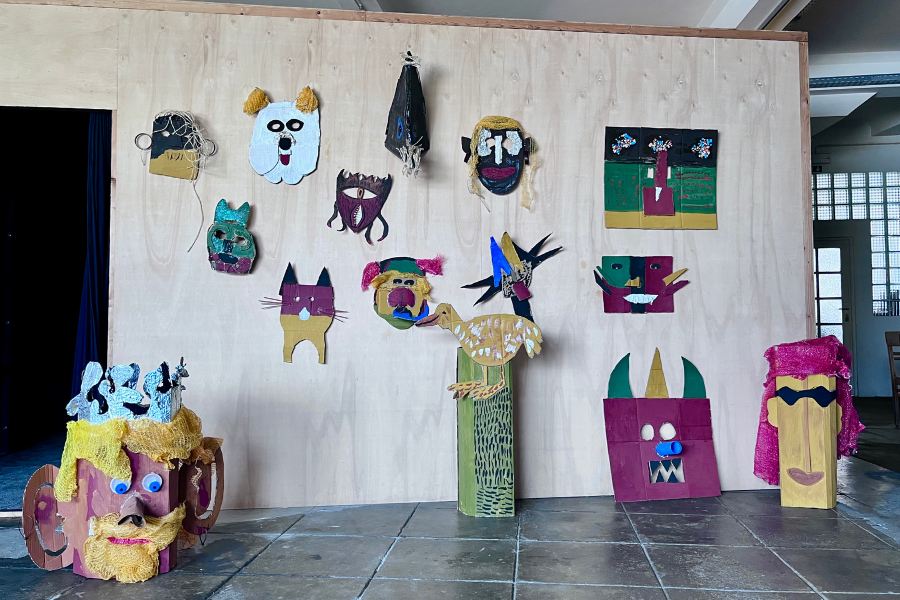
Image 5
Delegates experienced what happens when hip hop becomes a means of inclusion, empowerment and empathy as the group ‘O Grupo Ponto de Luz’ arrived to perform several hip-hop dances and to present their exhibition 'Masks', co-created with the artist Marielle Van der Berg during a residency at APECV (Image 5).
We discovered the ongoing, global ‘Textile Cartographies’ activism project led by APECV President Teresa Torres de Eça, which explores climate action by examining critical themes in the textile industries, and care for our planet through the practice of working in communities with recycled fabric and embroidery. We added to this growing textile archive by each embroidering a 10x10cm square of recycled cloth in a workshop led by Teresa, engaging in critical dialogue as we stitched, weaving our experiences into words and patterns on the cloth’s surface or disrupting the square format altogether (Image 6).
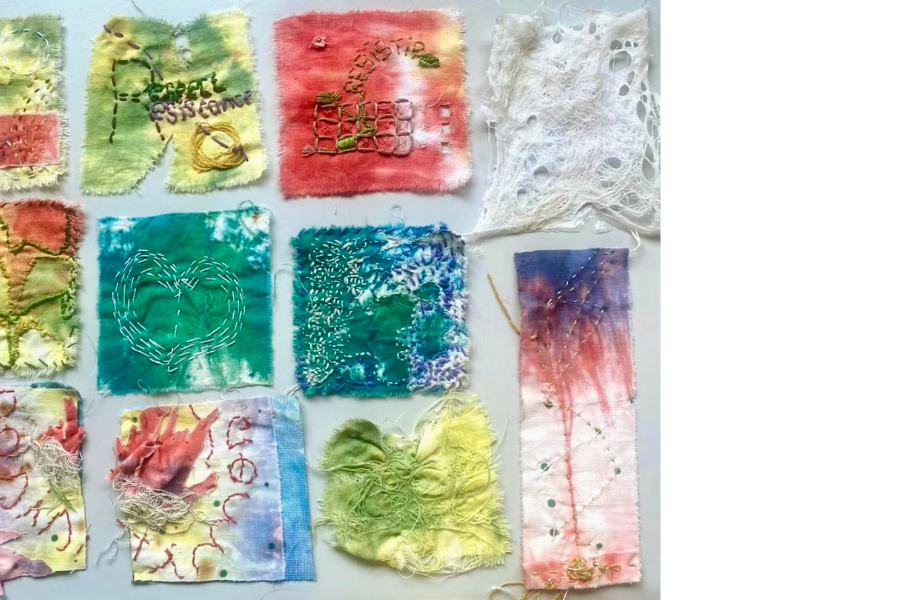
Image 6
APECV also outlined the ‘Gypsy Stories’ project, that aims ‘to rescue the centuries-old Gypsy component of Portuguese culture from invisibility through the creation of content that promotes the inclusion of aspects of Gypsy history and oral literature in the curriculum’ (APECV).
Presentations from NSEAD delegates included General Secretary Michele Gregson’s reflections on the state of art, craft and design education in the United Kingdom and the NSEAD’s inclusive work advocating for our subject and supporting members. Michele explained the impact of important work the society has completed in recent years through The Big Landscape curriculum project, the national Oak Academy Art and Design resources and the work of the Anti-Racist Art Education Action (ARAEA) group in empowering members to embed anti-racist practices across their creative curricula.
NSEAD President Andy Ash troubled the plurality of roles art educators inhabit – as role models, activists, researchers and collaborators – and the impact of this. President-Elect Emma Sutton shared approaches to developing a curriculum of care, through projects which activate joy and the power of play. Emma encouraged discussion around the importance of cultivating a welcoming classroom environment, the role of accident and chance in art making, and the art department as a centre for therapeutic practice alongside students.
We started the exchange as like-minded strangers and ended it as caring, critical friends. We engaged in fascinating conversation, shared our frustrations and hopes, made work together through material exploration and came to understand cultural histories through walking. As Andy Ash concluded, ‘though we work in different education systems, speak different languages and operate within different cultural contexts, we are united by a shared belief in the transformative power of art and design education.’
It is hoped that this inaugural exchange will become an annual European gathering to share innovative practice in art and design education, and that the critical conversations we started will continue to meander, gathering more voices, collaborators and journeying father and wider in the years that follow. Do join us at future events as we seek to build upon these foundations, after all, we are stronger together.
NSEAD warmly thanks APECV for hosting our inaugural exchange. Their generous provision of venue space and meals made it possible for the NSEAD delegation to take part, with delegates individually covering their remaining expenses.
About the author
Rebecca Twiston-Davies is an educator, artist and researcher, and has worked as an art teacher in state and independent schools in England for over 15 years. She has a practice-based MA in Art & Design education from the Institute of Education (UCL). Her own art practice takes a cross-disciplinary ‘thinking through making’ approach, focussed on material engagement. Her work in schools is underpinned by a belief in the power of art, craft and design education to make visible young people’s creativity, agency and ideas. She currently teaches at St. Christopher School in Letchworth, where a progressive ethos and a focus on departmental collaboration enables innovative curricula and creative, community-based educational projects to flourish.
Images
Image 1. NSEAD delegation: Andy Ash, Clare Stanhope, Michele Gregson, Emma Sutton & Rebecca Twiston-Davies (L-R).
Image 2 (Header). Rights Representation Workshop, shadow theatre. Image Credit: Casa da Imagem (29 July).
Image 3. Rights Representation Workshop. Image Credit: Casa da Imagem (29 July).
Image 4. ‘F[r]iction as a Critical Metaphor in Environmental Art Education’ workshop led by Claudia Ormonde, pictured top left.
Image 5. ‘Masks’ exhibition by ‘O Grupo Ponto de Luz’, co-created with artist Marielle Van der Berg and APECV.
Image 6. ‘Textile Cartographies’ workshop outcomes. Photo Credit: Casa da Imagem (28 July).
Links
Association of Teachers of Visual Expression and Communication (APECV): apecv.pt
Foundation Manuel Leao and Casa da Imagem: fmleao.pt/casa-da-imagem-e-museu