The Witch’s Hat
Taking its name from the fairground ride, the ‘Witch’s Hat’ theory – developed by artist educator Alison Hermon – illustrates how a pedagogy of ‘collaborative creativity’ can promote self-efficacy and agency in children and novice, non-specialist teachers in primary art and design.
What is the Witch’s Hat?
The Witch’s Hat is a new, unique theory (Figs 1 and 2) developed from my doctoral research exploring how collaborative creativity can be applied to primary art and design. The aim of this is to promote children’s and novice, non-specialist teachers’ self-efficacy – having self-belief in their own capabilities for developing their agency.
I selected collaborative creativity as it upholds the view that everyone has the potential to be creative when they collaborate, underpinned by the power of this pedagogy to foster individual creativity. For this reason, the Witch’s Hat supports an artistic communities of practice (CoP) ethos in the primary classroom: a learning environment promoting collaborative creativity as part of a cross-learning approach. This means that teachers and children are encouraged to adopt reciprocal roles as creative collaborators, creative artists and creative teachers – fostering important values of democracy, trust and mutual support. To date, the Witch’s Hat has been tested in the classrooms of three primary schools.
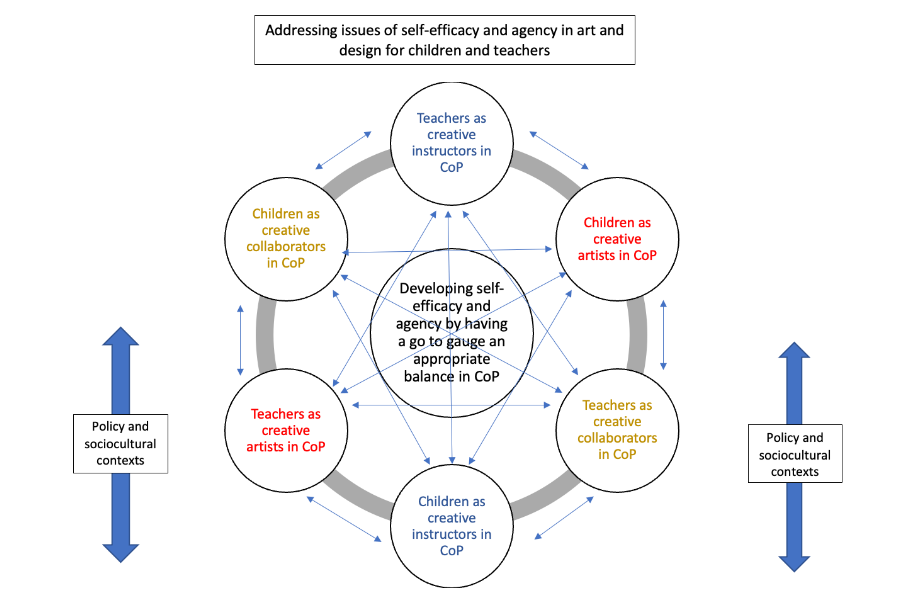
Fig 1.
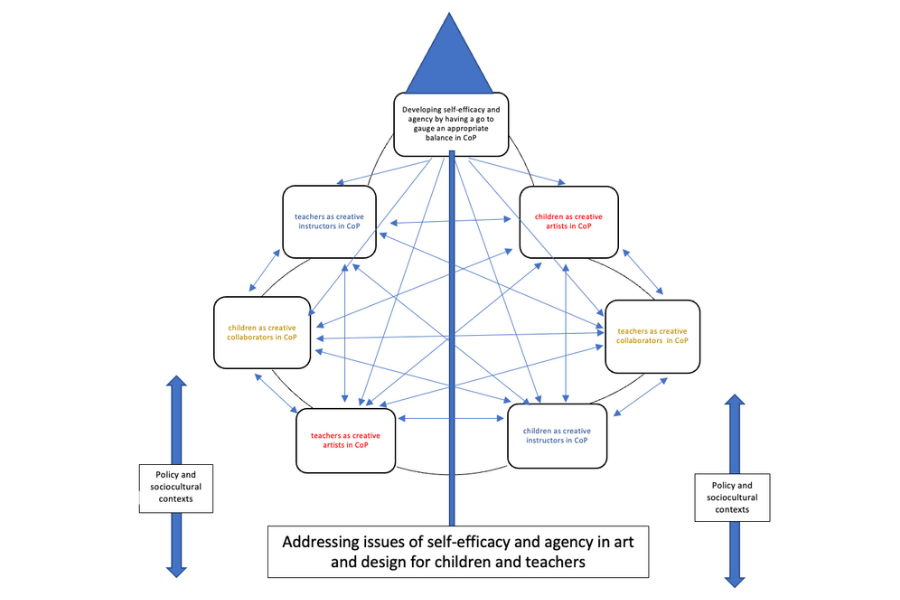
Fig 2.
Why was the Witch’s Hat developed?
The Witch’s Hat was developed to address problems of self-efficacy among children and teachers in primary art and design, arising from an imbalance between teacher instruction and pupil agency. I became aware of this issue as an art tutor in teacher education, when I noticed non-specialist primary trainee teachers planning ‘correct’ responses from pupils during art lessons. This approach accentuated teacher instruction at the expense of children’s artistic agency. In contrast, other trainee teachers upheld a ‘there’s no right or wrong in art!’ view, which prioritised children’s artistic agency over teacher instruction.
Through further research, I recognised that these two positions could constrain pupils’ self-efficacy in art and design. Too much emphasis on teacher instruction could hinder children’s agency to make their own choices, and too much emphasis on children’s agency could hamper teacher instruction informing pupils’ self-efficacy (Fig 3). For these reasons, a balance of both teacher instruction and children’s agency was needed to support pupils’ self-efficacy in primary art and design.
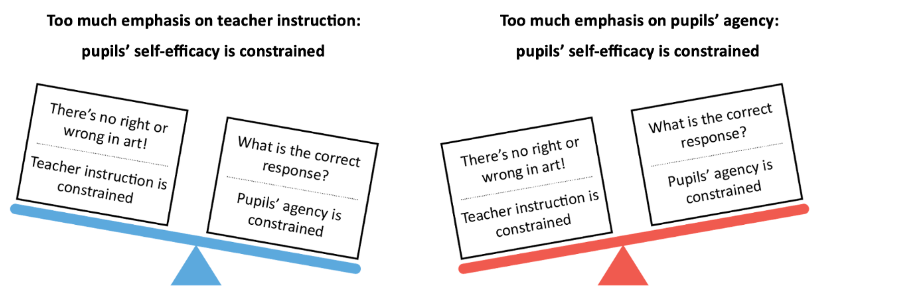
Fig 3.
Nevertheless, my research found that teachers needed to gauge a balance that was appropriate for learning intentions – requiring different levels of instruction and agency according to the subject matter and pupil group. At the same time, I understood that this could be a problem for novice, non-specialist primary teachers, often themselves lacking self-efficacy in teaching art and design. This was a position not helped by the decline in subject provision, training and experience in English primary schools. In addition, the government’s focus on teacher performativity and standardised testing appeared to cause conflicts for teachers trying to promote creative, artistic opportunities characterised by risk and uncertainty whilst also attempting to meet teaching competencies.
From this perspective, I recognised that primary trainee teachers planning ‘correct’ responses in art lessons may also be a response to deterring their fears about making mistakes. Similarly, upholding a ‘there’s no right and wrong in art’ view may be a way of releasing them from negative judgement. Indeed, my research pointed to how government policies were features of teachers’ previous schooling as well as current work, contributing to their feelings of oppression and low self-efficacy.
Consequently, to help liberate children and novice, non-specialist teachers from these oppressive policies, the collaborative creativity of the Witch’s Hat encourages a power sharing pedagogy embedded in two key theories by the Brazilian educator, Paulo Freire (1970) and the French philosopher, Jaques Rancière (2010).
Drawing on Freire’s theory, the Witch’s Hat highlights a reciprocal cross-learning approach in the classroom in which teachers and children swap roles to develop a mutually creative, trusting and democratic partnership to teach each other. In addition, recognising Rancière’s theory, it also upholds a single intelligence in teacher instruction. Rather than positioning pupils’ intelligence as inferior to teachers’ intelligence, or as separate from teacher instruction, the Witches Hat values both within its pedagogy.
I found that promoting these theories in artistic communities of practice could support teachers gauging an appropriate balance of instruction and agency, while also helping address low self-efficacy.
How does the Witch’s Hat operate?
The collaborative creativity of the Witch’s Hat operates as a dynamic six-point balance, promoting the self-efficacy and agency of children and novice, non-specialist teachers in primary art and design.
This structure developed from initial sketches in my reflective diary (Fig 4) when I saw its resemblance to a Witch’s Hat playground ride, comprising a conical swing balanced on a central pole. I saw how features of this ride could help develop the Witch’s Hat model. This included the risky and unpredictable, yet exciting and enjoyable nature of the ride, which aligned well with art and design qualities, but also reflected the security offered by artistic communities of practice.
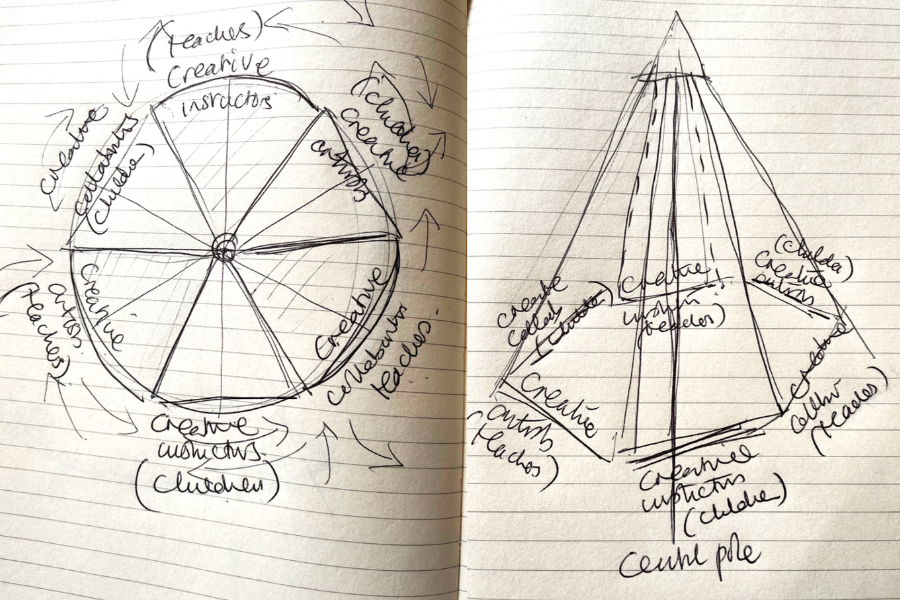
Fig 4.
Reflecting these features, the Witch’s Hat central pole represents the self-efficacy of the classroom community, and the hexagonal conical swing balanced on its top represents the agency of children and teachers in their reciprocal roles as creative artists, collaborators and instructors, located opposite one another.
Although the aim of the Witch’s Hat is for all members of the class to develop their self-efficacy through ‘having a go’ to support ‘gauging an appropriate balance’, the interactions between them cause the Witch’s Hat to oscillate in different directions according to the roles they adopt. This movement will depend on the approach taken by the teacher and the lesson phase in which teachers and children adopt a combination of roles, including those in parallel with one another, together with those more focused on either teachers or children.
In relation to these positions, my research found that all members of the class assumed parallel roles when they interacted with each other as creative artists, collaborators and instructors in artistic communities of practice, promoting ‘We are all artists!’
In this context, teachers shared their love and excitement as creative artists in whole-class, group or individual activities, which encouraged children to feel the same. This included those teachers who lacked confidence as creative artists who, supported by the cross-learning context, were given an opportunity to have a go as learners to develop their self-efficacy, which was perceived as growing with the children. While this was a helpful position for relieving the pressure on non-specialists to be experts, it also inspired children with low self-efficacy to have a go. Indeed, adopting these shared parallel roles in combination with a context highlighting support, trust and positivity, helped to promote an appropriate balance between agency and instruction, while developing the self-efficacy and agency of all.
These activities were also combined with roles more focused on teachers, such as when teachers adopted positions as creative instructors, collaborators and artists to support pupils as creative artists. In relation to these interactions, I recognised the importance of teachers trying an art task before the lesson to inform and understand the activity in sufficient depth. This preparation boosted their self-efficacy as creative instructors and collaborators to gauge an appropriate balance according to subject matter and pupil group. For instance, they acknowledged potential pitfalls of a task, as well as accessible ways to overcome them, in Q&A sessions and demonstrations. These approaches supported whole-class, group or individual work and motivated children’s attitude towards having a go to develop their self-efficacy as creative artists in their own artwork.
My research also identified roles more focused on children, including pupils assuming positions as creative instructors, collaborators and artists to support their peers and teachers as creative artists. These roles were promoted through a cross-learning ethos that encouraged having a go and interactions that helped gauge an appropriate balance. For example, children became teacher instructors when they shared their work as creative artists with excitement and pride in their spontaneous discoveries and/or when prompted by the teacher through planned questioning or demonstrations. This was evidenced when the teacher asked children to explain and/or show a task to a pair, small group or the whole class, reflecting the importance of promoting children’s knowledge in teacher instruction underpinned by values of democracy, trust and mutual support.
Whilst these roles and practices were also adopted in planned group work, teacher guidance was important at the beginning of the lesson to promote the values of artistic communities of practice, and throughout the lesson to address problems arising, particularly those concerning communication, collaboration and power sharing. By maintaining a communities of practice ethos, teachers could support the ongoing negotiation and balance between agency and instruction, fostering the self-efficacy of all members of the classroom community.
About the author
Dr. Alison Hermon recently retired from her position in Art and design Teacher Education at the University of Brighton, having previously worked in primary, secondary, special and gallery education contexts. Alongside her creative practice in sculpture, Alison’s current research is focused on supporting non-specialist primary teachers in art and design.
Images
Fig 1. Bird’s Eye View of Witch’s Hat
Fig 2. Side view of Witch’s Hat
Fig 3. Pupils’ self-efficacy in art and design is constrained either by too much emphasis on teacher instruction or too much emphasis on pupils’ agency
Fig 4. Reflective diary sketches of Bird’s Eye View and Side View of Witch’s Hat
References
Freire, P. (1970) Pedagogy of the Oppressed. Penguin Random House.
Hermon, A. (2024) Helping novice, non-specialist teachers foster self-efficacy in primary art and design through collaborative creativity: the role of balance between agency and instruction. [Unpublished doctoral thesis]. University of Brighton.
Rancière, J. (2010) On ignorant schoolmasters. In Bingham. C, & Biesta, G. (Eds.), Jacques Rancière: Education, Truth, Emancipation (pp. 1-24). Continuum. doi.org/10.5040/9781472546975